Brown Sugar Pavlovas with Mascarpone Cream

My husband and I have never been out to dinner for Valentine’s Day. On our first Valentine’s Day together, only a couple months after we started dating back in college, my husband took me on a picnic. He had spent the morning tucking homemade sandwiches and cookies into a cute little picnic basket and afterwards we went to Barnes and Noble. Since I don’t love eating in the grass, we don’t picnic as much anymore but we always make something a little messy and labor intensive together for a special dinner at home. We love being in the kitchen together and so we celebrate each other by doing something that we enjoy! In the past we’ve made gnocchi, homemade pasta, beef bourginon…anything that takes a little extra effort. This year we are making chicken bhuna (which is my favorite Indian curry) and homemade naan. Love is in the air!

Also since it’s Valentine’s week, your Instagram feed is probably starting to look a little like fifty shades of chocolate, so I thought I would switch it up and give you these brown sugar pavlovas. Sometimes, meringues and pavlovas can be overly sweet and not my favorite dessert, but the addition of brown sugar gives these a more rounded, caramelized flavor. The mildness of the mascarpone and sharpness of the fruit also helps to off set that sweetness. These are great to help you use up leftover egg whites and fruit that is starting to go bad. I used a little of the leftover beet creme anglaise to give the mascarpone cream that pink tint, but you could definitely leave it out or play with adding another flavor (strawberry or raspberry jam would be great). They are also fun to decorate so I encourage you to play around with them!

Brown Sugar Pavlovas with Mascarpone Cream

Yield: 4- 4” pavlovas

Ingredients: 

for the pavlovas: 

3 egg whites (125 g)

1/2 cup sugar

1/2 cup brown sugar

for the mascarpone cream:

1/2 cup mascarpone cheese

1/2 heavy cream

2 tbsp sugar

2 tbsp beet creme anglaise *optional*

Procedure: 

For the pavlovas: 

  1. Preheat oven to 250 degrees. Use a ramekin or round bowl to trace 4 4” circles on a piece of parchment paper. Flip the parchment over so that the lines are on the bottom side and place it on a sheet pan. 

  2. Whisk egg whites, sugar, and brown sugar together in a heat proof bowl and place over a medium saucepan with simmering water. Cook, whisking often until warm and frothy and the sugar is dissolved. Transfer to the bowl of a stand mixer. 

  3. Beat with the whisk attachment on medium high speed until stiff peaks form and meringue is cool and glossy (about 5 minutes). 

  4. Divide the meringue into 4 and spread inside the drawn circles. Create a small nest by pushing the sides a little higher than the center. 

  5. Bake for 40 minutes, until meringues are dry and can be gently lifted off of the pan. Turn oven off and let meringues cool in the oven for at least 1 hour. 

For the mascarpone cream: 

  1. Place all ingredients in the bowl of a standing mixer and whip until smooth and soft peaks form. Don’t over mix or the mixture will become gritty. 

To assemble: 

1. Filled cool meringue nests with mascarpone cream and top with fresh fruit and herbs. 

Chocolate Soufflés with Beet Crème Anglaise

SoufflesBrightEdit.jpg

I think that February is the best month for desserts. It’s post-holiday madness, which means there are less extraneous events and celebrations to take up your time, and it’s still technically winter so cozy activities, like baking projects, are high up on our to-do list. Also, Valentine’s Day gives us an excuse to consume more chocolate than we should and a reason to bake something special for someone we love. Enter these chocolate soufflés.

Soufflés can be super daunting, but they don’t have to be! The backbone of soufflé making comes down to basically two sauces- pastry cream and crème anglaise. They are very similar in how they are made and are both a milk/cream based sauce thickened with eggs. The only real difference is that pastry cream also has a starch added to it, which means you cook it slightly longer to cook out the flour taste. To make these soufflés, you start by making a chocolate pastry cream. You then beat a bunch of air bubbles into egg whites and sugar to create a smooth, luxurious meringue that you fold into the pastry cream along with some more eggs. Lots of eggs. Ta-da! You have a soufflé.

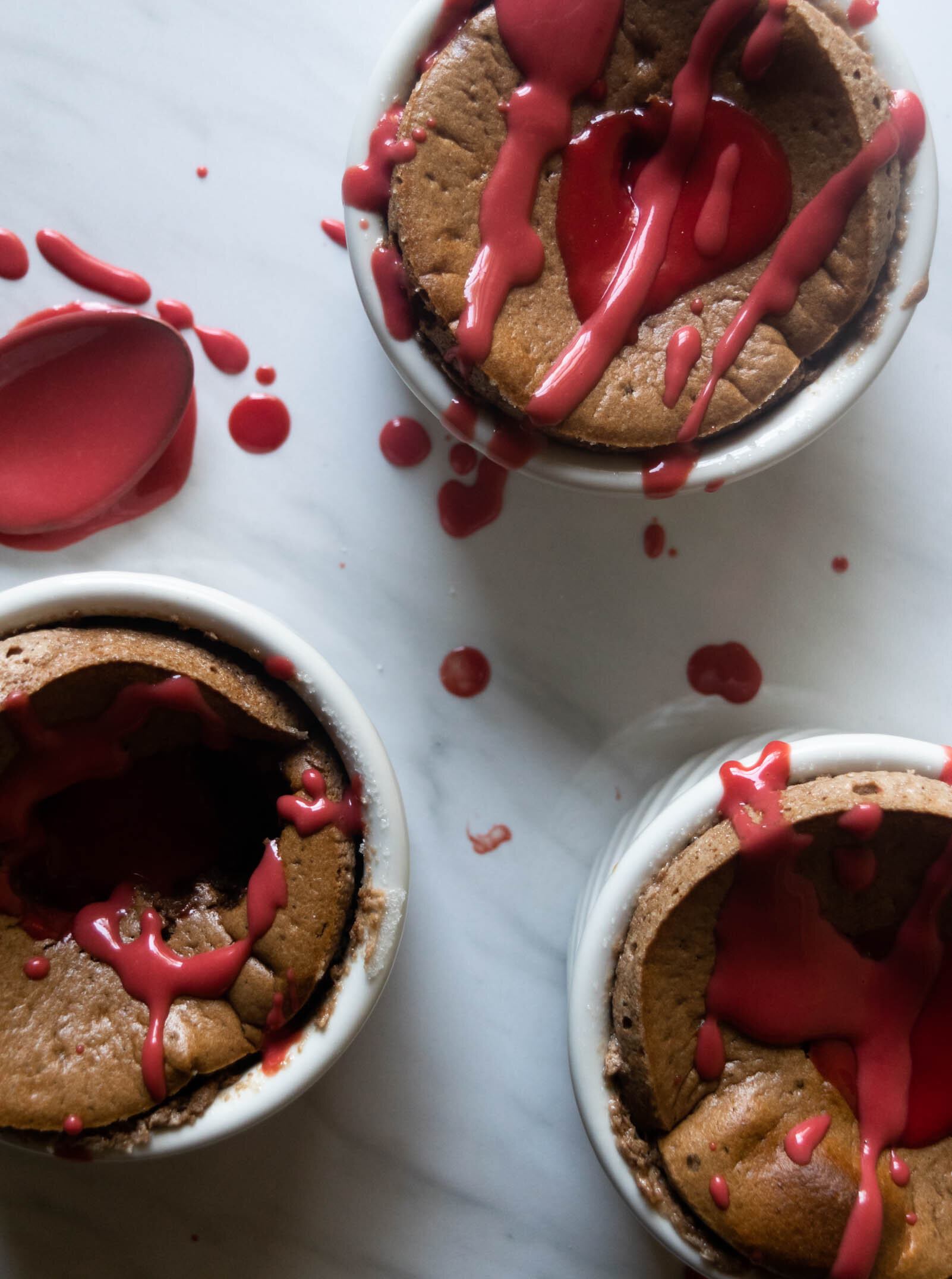
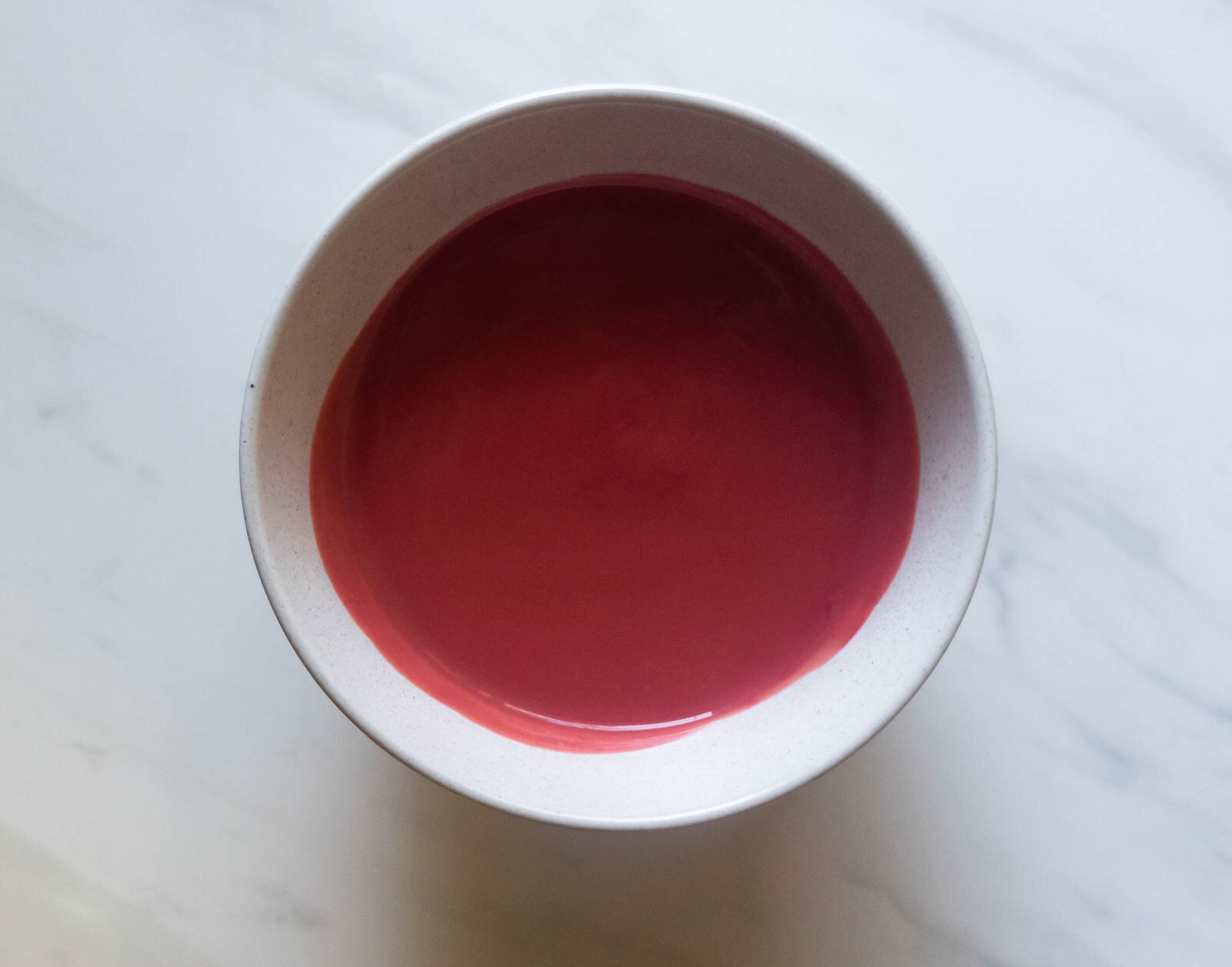
When the soufflés come out of the oven (working super quickly so that they don’t deflate), you use a spoon to poke a small hole in the top of each soufflé and you pour some creme anglaise inside. This creates a kind of melted ice cream in the pudding part of a molten cake feel and it’s perfect. I wanted my crème anglaise to be pink because Valentine’s Day and all, but I wanted to color it using something that would provide a subtle, yet complex flavor. I chose to use beets and simply steeped them in my milk before making the crème anglaise to give that pretty fuchsia color. You could use strawberries or raspberries, or nothing at all, if you wanted to, but the beets give the final product a unique flavor that I love.

Soufflés are very time sensitive and need to be served right as they come out of the oven, but you can make the pastry cream and the crème anglaise ahead of time. This makes for a pretty simple, but show-stopping dessert, perfect for the ending to your Valentine’s dinner!

Chocolate Souffles with Beet Creme Anglaise

Yield: 8- 6oz ramekins

Ingredients:

for the beet creme anglaise: 

3/4 cup heavy cream

1/4 cup milk

1 tsp vanilla

3 egg yolks

1/4 cup sugar

1/2 beet, chopped


for the chocolate pastry cream:

1 cup milk

1 cup heavy cream

1/2 cup sugar

1/2 cup flour

1 egg 

1.5 oz egg yolks (2-3)

3 T butter

6 oz dark chocolate, chopped

for the souffles: 

chocolate pastry cream, recipe above

4 egg yolks

5 egg whites

1/4 cup + 1 T sugar


Procedure:

To make the creme anglaise: 

  1. Heat milk and cream in a medium saucepan until simmering at the edges (between 180-190 degrees). Add the beets, remove from heat, and cover with a lid. Let steep for 30 minutes and then strain out beets. 

  2. After the milk is strained, return to heat and bring back to a simmer. 

  3. In a medium bowl, whisk together egg yolks and sugar to make a paste. 

  4. When the milk is hot, pour some of it (about half) into the egg mixture, whisking continually. Pour the egg mixture back into the milk and return to heat. Heat, stirring continually, until thickened and sauce coats the back of a spoon. You don’t want this to boil, but you want it get up to about 180 degrees. 

  5. Strain through a mesh strainer and stir in vanilla extract. Set aside. 


To make the pastry cream: 

  1. Heat milk and cream in a medium saucepan until simmering. 

  2. In a medium bowl, whisk together the sugar and flour. Add the eggs and egg yolks and whisk to form a paste. 

  3. When the milk is simmering, add about half of it to the egg mixture, whisking continually. Pour the egg mixture back into the rest of the milk and return to the heat. Cook, stirring continually, until boiling and thickened. 

  4. Pour pastry cream through a mesh strainer. 

  5. Add butter and chocolate and whisk until smooth and combined. Press a piece of plastic wrap directly to the surface of the pastry cream and let sit at until room temperature. 


To make the souffles: 

  1. Preheat oven to 350 degrees. Coat 8 6-oz ramekins with butter (all the way up the sides) and sprinkle with sugar. 

  2. Place the egg whites in the bowl of a mixer fitted with the whisk attachment. Start mixing on low speed and, once frothy, increase speed to medium. When the whites start to get foamy, sprinkle in sugar and increase to high speed. Whip until medium-stiff peaks form. 

  3. Add egg yolks to the chocolate pastry cream and whisk until smooth. 

  4. Fold meringue into pastry cream mixture in three batches. 

  5. Divide batter into prepared ramekins and bake for 20 minutes. Do not open the oven door!

  6. Remove from oven and immediately use a spoon or a knife to poke a hole in the center of each souffle. Pour creme anglaise into the middle of the souffle and serve warm. 

Chamomile Cake with Blood Orange Mousse and Mascarpone Swiss Buttercream

There are a lot of things that I like about being in the pastry field, but being able to create special order desserts for momentous occasions takes the the cake (ha, see what I did there). A few weeks ago I had the opportunity to design and develop this cake for my dear friend’s bridal shower, an event that will stay with her, and me, forever. It is such a privilege for me to be a part of someone’s important celebration and to create something beautiful that they will remember forever. My friend Lauren, who this cake was designed for, tends to gravitate towards lighter, more delicate flavors, and since it is winter, I knew I wanted to use some sort of citrus in this cake.

To make the cake layers, I used a base vanilla cake recipe. I steeped a few chamomile tea bags in the milk and strained it off before adding it to the batter. Then, to make sure that the tea flavor really came through, I brewed an extra cup of chamomile and used it to soak my cake layers after they came out of the oven. The blood orange mousse was made by folding blood orange curd into whipped cream. This curd recipe is super versatile and you can use any citrus that you want in place of the blood oranges.

As the person who scrapes the icing off of the top of the cupcake or eats around cake edges so that I never have a bite with too much frosting, I was sure that I didn’t want to use a traditional American buttercream for this cake. American buttercream is made with powdered sugar and is often cloyingly sweet, not my cup of tea. For this cake, I used a Swiss meringue buttercream, which is much lighter and more balanced than most traditional sugary frostings. It is made by heating sugar and egg whites over a double boiler until the eggs have been heated to a temperature safe for consumption and the sugar has dissolved. You then transfer it to a mixer and whip it to form a medium-stiff meringue. A hefty amount of butter is added, piece by piece, until the buttercream begins to come together. Finally, I tossed in a little mascarpone and vanilla to flavor it. Voila!

This is a delicious (and lovely) cake in which most of the components can be made ahead of time. I hope that it inspires you to make something beautiful and share it with someone you love!

P.S. This beautiful photo was taken by my good friend LJ, who is the most generous friend and photographer. She is always willing to come teach me how to take better photos and she makes my desserts look extra pretty.

Chamomile Cake with Blood Orange Mousse and Mascarpone Swiss Buttercream

Yield: 1 3 layer, 8” cake

Ingredients:

for the mascarpone Swiss butter cream:

180 grams egg whites

210 grams granulated sugar

350 grams unsalted butter, very soft at room temperature

4 tablespoons mascarpone, at room temperature


for the blood orange mousse:

4 oz sugar

3 oz blood orange juice

1.5 oz water

Zest of 2 blood oranges

4.5 oz egg yolks

5 oz butter, softened

1 cup heavy cream

for the chamomile cake layers:

4 cups cake flour

2 cups sugar

2 tbsp baking powder

1 tsp salt

2 sticks unsalted butter, at room temperature

1 1/2 cups of milk

1 tbsp lemon juice

2 eggs, at room temperature

1 tbsp vanilla

4 tea bags of chamomile tea

Procedure:

to make the buttercream:

  1. Place the egg whites and sugar in a heat proof and place over a saucepan of simmering water, making sure that the bottom of the bowl does not touch the water. Heat, whisking frequently, until the sugar is dissolved and the mixture reaches 160 degrees. 

  2. Once it reaches temperature, transfer to the bowl of a stand mixer and whip with the whisk attachment. Whip on medium-high speed until medium-stiff peaks form and the meringue is glossy and smooth and has reached room temperature.

  3. With the mixer running, add the butter, a little at a time, until completely combined. Switch to the paddle attachment and continue to beat until all the butter is incorporated. 

  4. Add the mascarpone cream and continue beating until thick and smooth. Set aside until ready to assemble the cake. Place the egg whites and sugar into the bowl of a stand mixer. Whisk by hand to combine.

to make the mousse:

  1. Place the sugar, blood orange juice, water, and zest in a medium saucepan over medium heat and bring to a simmer. 

  2. In a separate, heat-proof bowl, whisk the egg yolks. When the liquid is simmering, stream about 1/2 into the eggs, whisking continually to gradually raise the temperature of the eggs. Add the eggs back into the liquid, still whisking, and return to the heat. 

  3. Cook, stirring constantly, until the mixture comes to a boil and begins to thicken. Remove from heat and immediately strain through a mesh strainer. Add butter and whisk to combine. 

  4. Cover curd with plastic wrap and chill for at least an hour. 

  5. When curd is cold, place heavy cream in the bowl of a stand mixer fitted with the whisk attachment. Whip on low-medium speed until bubbles begin to form, then increase to medium-high speed and whip to soft peaks. 

  6. Fold whipped cream into curd and return to the refrigerator until ready to assemble. Use as soon as possible, within 12 hours. 


to make the cake:

  1. Heat milk in a medium saucepan until bubbles begin forming around the sides. Add 3 tea bags to the simmering milk, cover with a lid, and remove from heat. Let steep, covered, for 30 minutes. Remove tea bags and strain milk, adding extra to return to its original volume if needed. Let cool until it reaches room temperature. Once milk cools to room temperature, add in lemon juice and stir. 

  2. Preheat the oven to 350 degrees. Spray 3 8” cake pans and line the bottoms with parchment paper rounds. 

  3. In the bowl of a stand mixer fitted with the paddle attachment, combine the dry ingredients and mix until well dispersed, about 30 seconds. 

  4. With the mixer on low speed, add the softened butter and 3/4 of the milk mixture. When the mixture has slightly combined, increase the speed to medium and beat for 2 minutes. 

  5. Scrape down the sides of the bowl and add the rest of the milk and one egg. Beat for 30 seconds to combine, then add the additional egg and vanilla. Beat for another 30 seconds or until everything is combined. Scrape down the sides of the bowl once more. 

  6. Divide batter evenly into the prepared cake pans and bake for 20-25 minutes, or until the tops spring back when touched and the sides of the cake begin to pull away from the pan. 

  7. Remove from oven and allow to cool in the pan for 10 minutes. Remove cakes from pan and let cool on a cooling rack until room temperature.

  8. While the cakes are baking, make the chamomile tea for soaking. Bring 1 cup of water to a boil and add 1 chamomile tea bag. Let steep for 5-10 minutes. 


to assemble the cake:

  1. When cakes are cool, carefully slice the rounded top from each cake, creating 3 flat, equal layers. 

  2. Drizzle or brush the tops of each layer with the chamomile tea. 

  3. Place one cake layer on a cake board centered on a rotating cake stand. Pipe buttercream in a ring along the outside edge of the cake to create a barrier.  Place about 1/3-1/2 cup of the blood orange mousse in the center of the cake and use a small offset spatula to spread the mousse into a smooth, even layer. 

  4. Place another layer of cake on top of the mousse and repeat step 3. Place the final cake layer on top. 

  5. Use an offset spatula or a knife to cover the outside and top of the cake with buttercream. Smooth the edges with a bench scraper. 

  6. Decorate with pretty (non-toxic) flowers and herbs.